
OILFIELD CIVIL & CONCRETE CONSTRUCTION
Oilfield Civil & Concrete Contractor
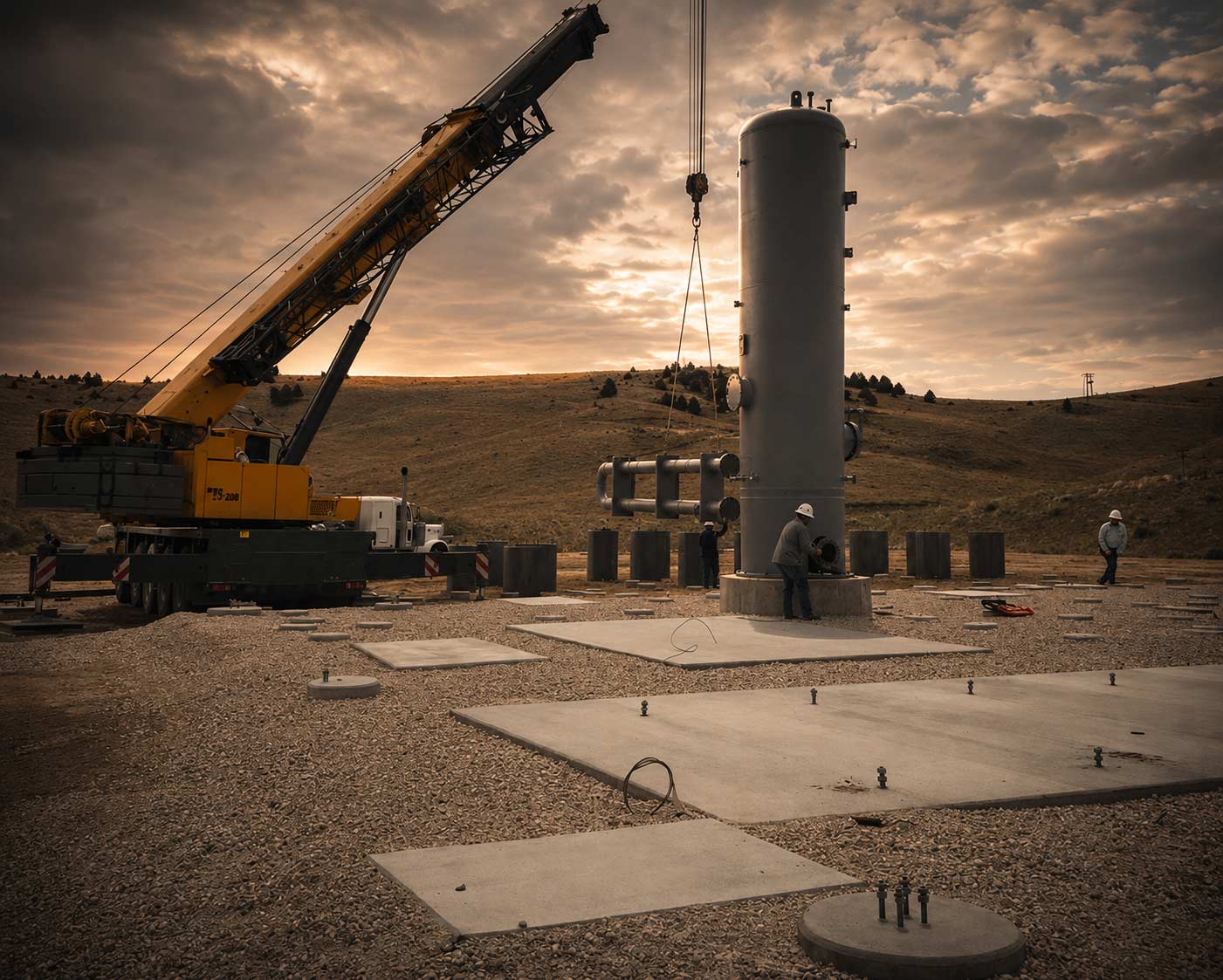
SPC executes industrial civil and concrete construction for oilfield, midstream, and energy infrastructure across West Texas. From bulk earthwork, moisture conditioning, and subgrade preparation to compressor foundations, tank ring walls, secondary containment slabs, and finish grading, our Kermit-based crews build stable, load-bearing civil assets throughout the Delaware and Midland Basins.
Subgrade → Site RestorationEarthwork. Foundations.
Earthwork. Foundations.
Containment. Finish Civil.
— Contractor Qualification & Field Compliance
Documentation & Field Safety in Place for Operator Review
Before civil earthwork or concrete placement begins, project teams require safety documentation, equipment readiness, personnel qualifications, and project-specific documentation. SPC maintains company safety programs, insurance records, and worker qualifications for review through industry compliance platforms, allowing project managers and safety teams to evaluate requirements before mobilization.
Compliance & Field Readiness
Operator Qualifications
Personnel are trained and qualified for their assigned earthwork, excavation, and concrete equipment, with operator certifications maintained where required by regulation, client policy, or equipment class.Contractor Compliance Profiles
Company safety policies, insurance coverage, and qualification records are maintained on ISNetworld and Veriforce.Worker Safety Orientations
Personnel complete required safety training and worker credentials, including SafeLandUSA orientation where specified, prior to site assignment.Permian Basin Mobilization
Operating from Kermit, Texas, SPC mobilizes earthwork equipment, concrete tooling, and field crews to project locations across West Texas.— Physical Scope & Execution Phases
Industrial Civil Execution from Subgrade to Site Restoration
Oilfield civil work requires structured coordination between earthwork, steel placement, formwork, and concrete curing. SPC executes civil construction from project controls and issued-for-construction (IFC) plans, ensuring ground preparation, structural foundations, containment structures, and drainage systems are installed to project specifications.
FIELD SERVICE
EARTHWORK → Foundations → Containment → Drainage → Restoration
[ 01 ]
SCOPE
Subgrade Preparation, Earthwork & Mass Grading
Establishing stable, compacted subgrades and pad surfaces designed to carry structural and dynamic equipment loads.Clearing & Earthwork
Site clearing, stripping, cut-and-fill operations, and redistribution or import of approved structural fill materials.Subgrade Conditioning & Compaction
Moisture conditioning, lift placement, and mechanical compaction performed to project lift-thickness and density criteria.Proof Rolling Support
Subgrade proof rolling performed to project requirements, with density verification and testing conducted by the project's designated third-party testing provider.Mass & Fine Grading
Mass pad grading, fine grading beneath foundations and containment areas, and aggregate base course placement.[ 02 ]
SCOPE
Equipment Foundations, Ring Walls & Structural Concrete
Forming and pouring heavy-duty concrete foundations engineered for static and vibrating facility equipment.Construction Layout
Field layout established from primary project control points and approved structural drawings.Formwork & Reinforcement
Excavation, form construction, and placement of specified reinforcing steel, welded wire reinforcement, dowels, and other reinforcing components shown in the IFC drawings.Anchor Bolts & Embeds
Placement and alignment of owner- or vendor-specified anchor bolts, sleeves, blockouts, pipe pass-throughs, and structural embeds prior to pour.Structural Concrete Placement
Placement, mechanical consolidation, screeding, finishing, and curing of compressor pads, pump foundations, vessel slabs, tank ring walls, and structural bases.[ 03 ]
SCOPE
Secondary Containment, Concrete Walls & Sump Basins
Constructing reinforced concrete containment slabs, walls, sumps, and curbs according to specified elevations, slopes, joint details, and fluid-control requirements.Containment Subgrade Prep
Subgrade shaping and base preparation for secondary containment areas, pads, and sloped drainage zones.Slabs, Curbs & Perimeter Walls
Monolithic or jointed containment slabs, perimeter concrete walls, curbs, and wall-to-slab keyways.Sumps & Drainage Slopes
Formed concrete sump basins, collection points, sloped surfaces directed toward sumps, and formed pipe penetrations.Joint Details & Waterstops
Installation of specified waterstops, expansion joint materials, and approved joint sealants where included in the scope.[ 04 ]
SCOPE
Site Access, Drainage & Finish Civil Work
Finishing the facility footprint with aggregate access roads, drainage controls, and pad stabilization.Backfill & Grading
Structural backfill around completed foundations, perimeter walls, and utility corridors.Access Roads & Approaches
Construction of aggregate facility access roads, equipment approaches, turnarounds, and road shoulders.Site Drainage & Erosion Control
Installation of drainage swales, ditches, runoff paths, and culverts, along with slope stabilization and pad-edge repair.Final Civil Restoration
Final grading, surface dressing, pad cleanup, and site restoration following concrete completion.— Civil & Concrete Risk Control
Field Controls for Civil Execution & Containment
Subgrade failure, misaligned anchor bolts, poor joint execution, or unmanaged surface runoff can create long-term maintenance costs and operational downtime. SPC applies field dimensional checks, compaction controls, reinforcing checks, and concrete placement procedures to execute civil assets according to approved IFC plans.
[ 01 ]
Subgrade Movement Under Loaded or Vibrating Equipment
THE RISK
Inadequate moisture conditioning, poor lift control, or insufficient compaction can lead to differential settlement under heavy compressor skids, charge pumps, or liquid storage tanks. Uneven settlement can crack concrete, alter equipment support elevations, and create recurring maintenance or corrective-work requirements.SPC APPROACH
Subgrade is prepared to specified elevations, moisture limits, and lift thicknesses. Moisture conditioning and compaction are executed to project specifications, with third-party density testing coordinated prior to forming or pouring.[ 02 ]
Cracking and Movement in Tank Ring Walls
THE RISK
Tank ring walls must provide continuous, uniform support beneath the tank shell while carrying substantial vertical loads. Soft subgrades, improper reinforcing placement, or poorly managed construction joints can contribute to cracking, localized settlement, and uneven tank support.SPC APPROACH
Ring wall subgrades are excavated, conditioned, and compacted to plan. Rebar structures are tied and inspected for clear cover, and concrete is placed using continuous pour management and mechanical consolidation.[ 03 ]
Standing Water and Uncontrolled Site Drainage
THE RISK
Improper pad grading traps surface water around foundations, containment areas, and access roads. Standing water softens subgrades, undermines slab edges, erodes shoulders, and limits heavy vehicle access.SPC APPROACH
Pads, containment floors, and site perimeter areas are graded to specified slopes and elevations. Drainage swales, ditches, and aggregate surfaces are finished to move surface runoff away from foundations and active work zones.[ 04 ]
Secondary Containment That Does Not Hold
THE RISK
Containment slabs, perimeter walls, sumps, and joint details must function as a unified fluid barrier. Weak wall-to-slab joints, uncompacted sump subgrades, or improperly installed waterstops allow liquid leaks into surrounding soils.SPC APPROACH
Subgrades beneath containment areas are compacted and fine-graded. Forms, reinforcing steel, wall keyways, sumps, waterstops, and joint materials are installed according to IFC details before concrete is placed and finished.[ 05 ]
Concrete Foundations Built Outside Equipment Requirements
THE RISK
Misaligned anchor bolts, incorrect top-of-concrete elevations, misplaced blockouts, or out-of-square forms prevent equipment skids and vessels from setting properly, creating field modifications and schedule delays.SPC APPROACH
Foundations and embeds are laid out from primary project control points. Anchor bolts, sleeves, and embeds are secured within templates and verified for centerlines, elevation, projection, and squareness prior to and during concrete placement.[ 06 ]
Erosion and Access Failure Around the Finished Site
THE RISK
A sound concrete pad can still fail operationally if access roads, shoulders, and pad edges wash out under heavy haul trucks or rain events, exposing foundation edges and impeding maintenance access.SPC APPROACH
Backfill around structures is placed and compacted in controlled lifts. Aggregate base course is applied to access roads and traffic areas, with slopes, ditches, and pad edges finished for long-term site stability.— Request Pricing
Request Pricing for Your Civil & Concrete Project
Send SPC your scope, current drawings, specifications, and site requirements. Our team will review the package, identify any missing information needed to define the work, and follow up regarding scope, schedule, and next steps.— Contact
TALK TO SPC.
Tell us what you’re scoping. An operations lead will respond within one business day.
PHONE
(832) 683-7470
HQ
P.O. Box 782
Kermit, TX 79745
Kermit, TX 79745
HOURS
Mon–Fri · 08:00–17:00 CT
— Headquartered · Kermit, TX